
Convention speech: Mickey Dollens — A citizen’s guide to political change
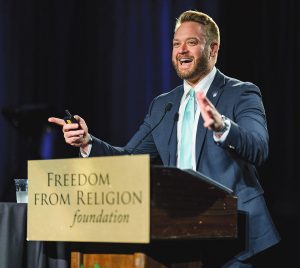
FFRF Regional Governmental Affairs Manager Mickey Dollens (and current Oklahoma state representative) speaks at FFRF’s convention in Myrtle Beach, S.C. on Oct. 17, 2025.
This is an edited version of the speech given by Mickey Dollens at FFRF’s national convention in Myrtle Beach, S.C., on Oct. 17, 2025. To watch the full speech, go to ffrf.us/con25.
By Mickey Dollens
My name is Mickey Dollens. I’m the regional government affairs manager for the FFRF Action Fund. And I’m also a current legislator from the OK state of Oklahoma. I say OK, but we’re doing a lot better now that Ryan Walters is gone. Am I right?
As skeptics and freethinkers, we like data research and evidence, including a recent study that said that only 19 percent of Americans surveyed contacted their elected officials in a particular year. Research also shows that legislators are up to 20 percent more likely to be influenced to vote the way you want just by one constituent reaching out. Another study showed that staffers often misestimate what the constituents actually want because they can’t represent what they don’t hear.
Today, we’re going to focus on the local level — the municipal and state level — where you have the most power to influence change, and where this legislation most likely impacts your life the most.
I understand that traditional civic engagement feels ineffective and, quite frankly, hopeless when you consider what we’re up against: religious extremism, the consolidation of power by the president, deploying federal troops in American cities, censorship and weaponizing the courts. If you’re feeling overwhelmed, drained, sad, and even disoriented, you’re not alone. In fact, it means you still give a damn.
People asked me just 10 minutes ago, how do you still have hope? I hear that all the time. Well, the people in this room give me hope. So, I’ve created this framework called the F.O.R.W.A.R.D method to help everyday people navigate legislatures, city councils, and how to effectively lobby their elected officials.
Cailey’s story
I want to take you back to 2017. I had just left the classroom. I was actually laid off due to budget cuts, so that’s why I decided to run for office. I went from the classroom to the state Capitol. One of my first experiences of being a legislator was when I walked into my tiny broom closet of an office in the basement of the Capitol, and sitting on my desk was a little postcard from a 10-year-old girl named Cailey.
She wrote, “Rep. Dollens, you just got elected. You represent me. I’m your boss. I want to tell you a story. I went to the Cleveland County Fair. I was having a great time with my mom and my grandma. We were riding rides, eating good food, playing games. And then I came across a carny game where they were using goldfish as prizes. I felt bad for them because half of them were dead. They were in this hot water, their belly up, so I wanted to do the right thing. I wanted to save at least one of these goldfish.”
So, she played the carny game, and then she played it again and again and then finally won a little goldfish and named it Ripples. She took Ripples home, put him in clean water, gave it fish flakes. But, unfortunately, the next day, Ripples was dead. So, she turned that sadness into passion. She asked her mom what could be done to save more animals? Her mom told her to reach out to her representative. I read this note and said, “Absolutely. This is exactly why I was elected — to help my constituents.”
I invited her and her family to the Capitol. We did our research. We found that quite a few states have banned pets as prizes. So, we filed the legislation in the first week of committee — nothing. Second week — still no word. I needed a chance to present the bill in front of the committee members. And then the third and final week. At this point, if you don’t get a committee hearing, the bill is dead. A more senior member came to me and said, “Have you lobbied for your bill?” I said, “No. I wrote the bill, I filed it, I did everything right.” He said, “No, no. You need to go talk to the committee chair and you need to go get a committee hearing.”
So, I go to the committee chair and tell him about the 10-year-old constituent who’s very passionate about how these living beings are being used as prizes. It’s a terrible thing. He said, “Dollens, you know, we’ve got bigger fish to fry.” I said, “Yeah, that was pretty good. But you’re a jerk.” So, I went back to Cailey and I said, “Cailey, I hate to break it to you, but we’ve got to pivot. We have to adapt.”
I wasn’t sure what to do, but then her mom suggested we reach out to the local news. That was a pretty good idea. I had made some relationships with local journalists and I knew they were overworked and always looking for stories. I reached out to the local news and a station covered the story, complete with interviews of Cailey and her mother and myself.
Well, two days after that story aired, I got a call from the county elected official who said he saw the news story. So, we arranged a meeting and they said, “Hey, Cailey, we saw your story. We’re blown away by your advocacy. We agree it’s not right. From this day forward, we’re going to pass a county ordinance banning pets as prizes in Cleveland County.”
Since that day, there have been four other counties across the state that have banned pets as prizes. While she didn’t get her ultimate goal, which was a statewide ban, she effected change at the grassroots level in her own backyard, but more importantly, equipped herself with the knowledge and confidence to continue making change.
My F.O.R.W.A.R.D framework is inspired by a 10-year-old. It works.
She found me as her stakeholder. She organized her messaging. She wrote and told a compelling story. She reached out to me as a watchdog, but I initially failed, so we had to adapt. We reached out to the local news, which resulted in raising awareness that ended up driving change.
We can take this F.O.R.W.A.R.D. idea from goldfish to Christian nationalism, because we’re up against a lot.
We’re seeing legislation that’s sweeping across the nation. They’re trying to take over public education. We’re seeing a judicial shift, unlike any other time. There are even some state senators from Oklahoma who are proudly holding up a Christian nationalist flag. They are so well funded and coordinated.
This is why it starts with your direct action and the path forward. Every tactic and every strategy I’m about to lay out is completely permissible. As individuals, you have the power to lobby. You have the power to endorse, to donate to campaigns, to even run for office. You can do all of that.
Find stakeholders
Let’s start at the basic level. We’re going to start off with F — Find stakeholders — because when I first ran for office, when I was trying to figure out what was going on in government, the first person I reached out to was my U.S. senator, and they immediately directed me back to the state level because the issue I was calling about had to do with education. So, whatever issue you take up, you want to be able to categorize it at the local, state or federal level.
Some of the big stakeholders at the local level are your school board members or city council members. At the state level in Oklahoma, each person has one House member and one state senator. And at the federal level, you’re going to have two U.S. senators, one U.S. House member. If you don’t know exactly who these people are, you can go to ballotready.org. Just put in your address. It’ll tell you exactly who your elected officials are, from the president down to your local school board member.
When you’re ready to reach out to them, you want to be able to navigate the chain of influence. Oftentimes when you call, you’re going to talk to a legislative assistant. This is gold. They are the direct connection to the lawmaker. They’re also policy experts. They have such a good pulse on the constituency. So don’t get frustrated if you’re not talking directly to the lawmaker to begin with. The legislative assistant is important.
The legislative staff members are the gatekeepers and subject matter experts. Many of them end up running for office themselves. If you build great rapport with the legislative assistant in the beginning, you very well could be likely building a great relationship with a future lawmaker.
Organize
Let’s move on to organizing.
People love a good story. I could have given you facts and data about pets as prizes across the country, and while that’s important and impactful, it’s nothing like an actual 10-year-old taking matters into her own hands and telling her story. It’s the best way to communicate, especially with lawmakers.
Our Action Fund resources [ffrfaction.org] are very pivotal in getting out this constitutionally sound messaging that is guaranteed to help you formulate a message that you can add your personal lived experience and to make it even more impactful.
Another great resource we have are these testimonies that you can go and look at and help frame even more of your message to add on to the Action Alert, if you’d like.
You simply go to “Submitted Testimony” under “News” and then it’s divided up by state, by bill number and the issue at hand. These are very important. Once you’ve got your messaging ready to go, you’ve got your story. You’ve got a few data and facts in there.
Reach out
It’s time to reach out. Here are the top five effective methods for reaching out to your legislators:
Of course, the first is in-person visits. But hey, I live in Oklahoma. How am I going to go to D.C.? Don’t forget that your U.S. senators and your U.S. representative have in-house districts where you can meet with the staffers. That’s important. Any time a constituent wants to meet, if you live far from the Capitol, ask for an in-district meeting.
Phone calls are also very effective. That’s the second-best way. And email messages are third. Add your personal story on it. Or send individualized postcard letters like Cailey did, which is fourth best. And social media posts made the top five. Well, now more than ever, I promise you, every elected official is reading the comments. They’re reading what people say. They’re taking screenshots. This is one way in which I communicate with my legislative assistant, too. Don’t overlook the power of social media.
I’ve already had a couple of people come up to me today and tell me they signed up for FFRF’s Action Alerts. That is great news. This is a perfect place to start. We give you the template, the foundation to put in your own lived experience. It’s already utilized and pre-written in the way in which we decide to send these to you at the beginning of the session. When all these bills are filed, we mark them. We are tracking the good bills, we’re tracking the bad bills, and as they start to move through the legislative process, we try to catch them, especially in the committee process, where it’s the easiest to kill a bill. Once that bill’s up for a committee hearing, we’ll get a notice, usually 24 hours in advance. Then we’ll send you the Action Alert. Once you get that, look it over, add your input, your lived experience. Be sure to include your name, include your zip code, which will identify you immediately as a constituent, and then use that pre-written template. But before you send the Action Alert, call your elected official’s office and talk to the legislative staffer. Use that script that you have from the Action Alert and then make note of that, get the staffer’s name, and say thank you. Be very respectful. Remember, they’re oftentimes overworked and underpaid. Once you hang up, add that staffer’s name to your Action Alert. Then press send.
Right after that, take what you just said and put it on social media. “I reached out to Representative Dollens’ office. I talked to Peyton. This is what I said.” Put in the Action Alert link and say, “You can take action, too.”
Boom. In 10 minutes, you just had three invaluable points of contact. That’s going to go a long way. If you don’t have 10 minutes, at the very least, just shoot off the Action Alert. It’s a lot better than nothing. Here’s one of the best ones I always hear. Should I reach out to my elected official, even if I’m sure they won’t listen? Yes, because if you don’t, you’re going to be silent, and silence is taken as approval. Silence is where bad ideas flourish. But if your elected officials are great, give them a compliment. Thank them for representing you. It’s going to motivate them to stand up, to take an even bolder position on the issue they love.
Watchdog
After you’ve reached out, we’ve got the watchdog part. Now there’s a lot of opportunities to be a good watchdog. Try to catch your lawmakers in their town halls if they’re still having them.
Report the violations. It’s one of the best things you can do as a watchdog, and you can report it anonymously to FFRF. Our legal staff will write a letter, if necessary. We’ll litigate it. It’s one of the best things you can do to be a good watchdog.
Adapt
Next is to adapt to challenges, and inevitably we’re going to run into challenges. That’s just the nature of government. It happens. That’s when you need to rely on our resources at the FFRF Action Fund and with our legal staff.
Politics is a long game. We have to keep at it. We can’t give up and we have to stay persistent. We also have to take care of ourselves.
Raising awareness
And here we are at raising awareness. I mentioned how getting Cailey’s story on the local news made a huge difference. These multimedia journalists are so overworked every single day. They’re responsible for finding a story, for editing it, for finding the interviews, and then they have to go present it.
So, if you have a good story like Cailey’s, they’re going to pick that up and then they’re going to say “thank you.” Then they’ll be going back to you and saying, “Do you have any more ideas like that?” It’s a great way to get your message out. Also, use your social media. You never know when a lawmaker will look at what you’re talking about.
We can even make that more impactful by tying it to a strike or a boycott. There’s one thing authoritarians kneel down to, and that’s the markets. We saw that with how effective it was when they reversed course just five days and $4.5 billion later after people started canceling their Hulu accounts.
Drive change
And then to wrap it up, we’re going to have to drive it home. FFRF and the Action Fund have the most comprehensive strategy for fighting Christian nationalism — more than anyone in the country, which is suitable because we’re the largest freethought organization in the nation. It all starts right here with the membership, educating the public, reporting violations, engaging in protests, sending out those Action Alerts.
That’s when our legal staff can come in and then take action on those reported violations. We write amicus briefs, we provide expert witness. We’re on the news. And then there’s the Action Fund. We’re endorsing good candidates. We’re lobbying against bad bills. We’re supporting good bills. We’re writing policy that now for the first time, we’re actually on offense instead of having to play defense. In the end, the Action Fund endorses great candidates who have the courage to put their name on the ballot.
Speaking of running for office, freethinkers need to run for office. We need more nonreligious people to run. I’ve talked to so many people who automatically disqualify themselves because of lack of faith. It couldn’t be further from the truth. There are 7,400 state legislator seats available every two years. At the municipal level, there are over 250,000 elected offices available around the country. There are more than 86,000 positions available for school boards. And one in three Americans are nonreligious, but we hold less than 1 percent of elected offices.
You don’t have to fake faith to win. I’ve been elected for 10 years. I never had to fake my faith, and I’ve always run as an authentic candidate. People ask what church I go to and I say, “I’m not a churchgoer, but I believe in transparency, accountability. Here’s my phone number. I’ll be here for you. I’ll fill a pothole. I won’t tell you what to believe. I won’t preach to you or anything. But I’ll help you out.”
Also, direct democracy. Whether it’s ballot initiatives, voter referendums, election recalls — all of that is so important. And it’s being stripped away in states across the country, including in Oklahoma.
Every time you take action as a citizen lobbyist, you move the needle forward. Whether reaching out to your elected officials, sending in Action Alerts, reporting a state/church violation, raising awareness, voting, volunteering or running for office yourself, you are making a difference. Each action creates ripples you may never fully see, touching the lives and changing minds in ways that matter.
Each of you in this room remind me that progress requires courage, and courage is contagious. It spreads from one brave voice to another, from one small act of resistance to the next, building momentum until little ripples become waves of change. And together, day by day, we will continue moving forward. Thank you.
