
FFRF condemns latest Supreme Court decisions
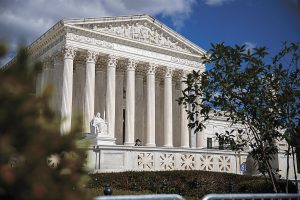
The U.S. Supreme Court ended its 2024-25 session with a flurry of rulings that did not sit well with the Freedom From Religion Foundation. Here’s a look at four of the most recent cases to be decided by the nation’s top court and FFRF’s reaction to them.
Planned Parenthood and Medicaid rights
FFRF condemns the Supreme Court decision that dismisses Planned Parenthood’s lawsuit against South Carolina for removing its clinics from the list of approved Medicaid providers.
The Supreme Court decided 6-3 in Medina v. Planned Parenthood of Southeast Atlantic that Planned Parenthood of the Southeast Atlantic and its patients cannot sue states under the Civil Rights Act for rights arising from the Medicaid Act.
South Carolina admitted early during the eight-year litigation that Planned Parenthood of Southeast Atlantic was a qualified provider for Medicaid care, but because it provides abortion care, it was targeted and removed from the list of qualified providers. Planned Parenthood won several times, including before the Supreme Court and three times before the 4th U.S. Circuit Court of Appeals.
Unfortunately, this time, the Supreme Court shut the door on Planned Parenthood and the millions of women who rely on state insurance to access family planning services.
South Carolina’s Christian nationalist officials have used every tool at their disposal to sabotage abortion access. Now, with the Supreme Court’s help, they’ve succeeded in denying patients their choice of provider — not based on quality of care, but based purely on religiously motivated opposition to abortion.
“The ruling is alarming not just for reproductive rights, but for government accountability,” says Liz Cavell, FFRF’s deputy legal director. “FFRF has long opposed efforts by Christian nationalist officials to impose their religious beliefs through government policy. When states strip access to qualified providers for ideological reasons, there must be a legal remedy. The court’s decision undermines both the rights of patients and the secular principles our Constitution is meant to protect.”
LGBTQ inclusive curricula
FFRF is appalled at the U.S. Supreme Court’s decision in Mahmoud v. Taylor, which opens the door for parents to opt out of inclusive public school curricula on religious grounds.
“This is a deeply troubling outcome for public education, equality and the constitutional principle of the separation between state and church,” says FFRF Co-President Annie Laurie Gaylor.
The case involves a group of religious parents who objected to LGBTQ-plus characters in storybooks that were approved for use in a Maryland school district. The parents claimed that their religious beliefs require the school to exempt their children from being exposed to the inclusive stories, demanding the right to withdraw children from classes on days when stories with LGBTQ-plus themes are discussed. The lower courts rightly declined to issue a preliminary injunction that would require schools to notify the parents when the storybooks would be used and provide them a chance to opt out of instruction. The lower court noted the “threadbare” evidentiary record and affirmed that public schools are not required to tailor their curricula to individual religious preferences.
Unfortunately, the Supreme Court’s extremist majority has now reversed that sensible approach and sided with the parents.
The court held in a 6–3 decision that LGBTQ-plus inclusive materials amounted to inculcation against faith and that not providing an opt-out to the plaintiffs violates their Free Exercise rights.
While the majority opinion paves a regressive path, the impassioned dissent in the judgment reaffirms that public schools exist to prepare students for life in a diverse and pluralistic society and not to shield them from it.
Justice Sonia Sotomayor authored the dissenting opinion, which was joined by Justices Elena Kagan and Ketanji Brown Jackson. The dissent reiterated that public schools are the “symbol of our democracy.” Sotomayor wrote, “They offer to children of all faiths and backgrounds an education and an opportunity to practice living in our multicultural society. That experience is critical to our nation’s civic vitality.” She warned, “Yet it will become a mere memory if children must be insulated from exposure to ideas and concepts that may conflict with their parents’ religious beliefs.”
FFRF had filed a friend-of-the-court brief before the Supreme Court to support the Montgomery County School Board. The brief emphasized that the parents had not cited a single precedent in which a neutral curriculum policy was invalidated based solely on claims of hostility to religion. Courts have consistently ruled that parents do not have a Free Exercise or Due Process right to insulate their children from ideas they find objectionable in public education.
“As our brief detailed, for nearly a century, parents claiming that mere exposure to history, science or life skills that conflict with their religion have uniformly lost on that point,” adds FFRF Legal Fellow Hirsh M. Joshi, who helped author FFRF’s amicus brief. “But every day is a new day to favor religion over decades of well-settled legal precedent.”
Birthright citizenship
FFRF has added its voice to the widespread condemnation of the June 27 Supreme Court ruling in which the court essentially barred lower courts from issuing nationwide injunctions to protect constitutional birthright citizenship.
The 6–3 decision means the court has diminished the impact of the federal judiciary’s checks on executive power, requiring every victim of a blatantly unconstitutional executive order to litigate to vindicate their constitutional rights.
“With the stroke of a pen,” as Justice Sonia Sotomayor writes in her dissent, joined by Justices Kagan and Jackson, “the president has made a ‘solemn mockery’ of our Constitution.”
“The court’s decision to permit the executive to violate the Constitution with respect to anyone who has not yet sued is an existential threat to the rule of law,” warns Justice Ketanji Brown Jackson in her passionate separate dissent. “This ruling should send a chill down every American’s spine.”
The language of the 14th Amendment could not be more clear: “All persons born or naturalized in the United States, and subject to the jurisdiction thereof, are citizens of the United States and of the state wherein they reside.”
The Supreme Court decision saying a federal judge cannot order the president to adhere to the Constitution amalgamates more power to itself by disempowering lower courts, but also grants the office of the president nearly unfettered powers. The decision will create acute misery and inequity across the land, clogging our courts and victimizing those without the means to sue, while eroding America’s precious constitutional principle of “equal rights under law.”
Gender-affirming care
FFRF lambastes the U.S. Supreme Court ruling upholding Tennessee’s cruel and unconstitutional ban on gender-affirming care for minors. This decision is a major blow to science-based medicine and the rights of parents and transgender youth.
In the 6–3 judgment written by Chief Justice John Roberts, the majority held in United States v. Skrmetti that states may prohibit gender-affirming medical care for minors without violating the 14th Amendment’s Equal Protection Clause. The extremist majority bought the state’s argument that its law does not discriminate based on sex, because it applies to all minors regardless of their sex assigned at birth — i.e., both males and females are prohibited from undergoing gender transition treatments.
Justice Sonia Sotomayor read her dissent from the bench, calling out the conservative majority for “refusing to call a spade a spade. Instead, it obfuscates a sex classification that is plain on the face of this statute, all to avoid the mere possibility that a different court could strike down SB 1, or categorical health care bans like it.” She lamented the decision’s “irrevocable damage to the Equal Protection Clause,” and its invitation for state legislatures “to engage in discrimination by hiding blatant sex classifications in plain sight.” She concludes: “It also authorizes, without second thought, untold harm to transgender children and the parents and families who love them. Because there is no constitutional justification for that result, I dissent.”
“This decision is a clear example of religious ideology permeating the law,” says FFRF Legal Director Patrick Elliott. “It undermines both parental rights and medical freedom, and signals a dangerous willingness by the court to allow theology to dictate constitutional rights.”
Despite the hostile narrative surrounding transgender health care that the Supreme Court is furthering in its decision, the gender-affirming-care model is safe, effective and supported by every major medical organization, including the American Medical Association, the American Psychiatric Association, the American Psychological Association, the American Academy of Pediatrics and the American Academy of Child and Adolescent Psychiatry.
FFRF stands firmly with the transgender community, with parents, and with the medical professionals who follow science and ethics in providing care.
