
Oxford debate: ‘This house believes God is a delusion’


By Dan Barker
In November 2012, the same week President Obama won his second national election, I was at Oxford University to debate the proposition “This house believes in God” for the Oxford Student Union. Along with me were philosopher Peter Millican and skeptic Michael Shermer. Our opponents were Peter Hitchens (brother of Christopher), mathematician John Lennox and Anglican priest Joanna Collicut. At the end of the debate, the students voted with their feet by exiting through either the Proposition or Opposition door. The vote was 143 to 168, which means we won by a greater margin than Obama did that week.
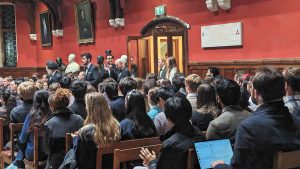
Eleven years later, on Nov. 23, 2023 (Thanksgiving Day in America), I was invited back for another Oxford debate. Since the Oxford debate tradition started in 1823, this was its 200th anniversary. This time the proposition was reversed: “This house believes God is a delusion.”
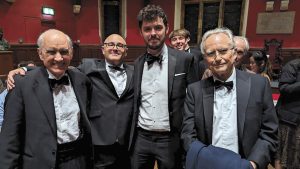
I was joined by sociologist and author Phil Zuckerman and by Oxford graduate Alex O’Connor, founder of the “Cosmic Skeptic” podcast. Our opponents were African Catholic Cardinal Peter Turkson (who some say is in the pool of potential future popes), Hindu author Amish Trepathi and Indarjit Singh, a Sikh who is a member of the British House of Lords. Kicking off the debate were two eloquent statements by Oxford students Chloe Davis for the proposition, who argued that most god arguments can be replaced by science, and David Logan for the opposition, who argued that the appearance of “fine tuning” is evidence for a designer.
Phil, Alex and I had coordinated our remarks. Phil energetically introduced the topic from a sociological perspective by asking: If god belief is not a delusion, why is there so much suffering in countries with high levels of theism? Alex also articulately addressed the problem of suffering from a scientific perspective.
It appears that none of the invited speakers on the other side had communicated with each other, much less organized to put up a united front. They gave unconnected independent lectures on the virtues of their respective faith traditions that barely made reference to the topic.
My job, as the final speaker for the proposition, was to rebut arguments raised by the other side. But the only serious argument came not from any of the invited speakers but from the student David Logan’s defense of “fine tuning.” Trepathi did insist that God cannot be a delusion because, ultimately, we are all gods, but I considered that more a statement of Hindu faith than an intellectual argument. Cardinal Turkson and Lord Singh, who put up no arguments, essentially asserted that there is no conflict between their faith and science.
In my opinion, the whole debate came down to “fine tuning” — the idea that the initial constants of the universe appear exquisitely tuned to permit life. Since my next book Contraduction (to be published later this year by Hypatia Press) is about that topic, I was prepared. After briefly telling my preacher-to-atheist story and offering six quick reasons why “God” is a delusion, I likened the “fine tuning” argument to the person who is amazed at how so many rivers were made to flow along state borders. Of course, that is backward. The rivers came first. As astrophysicist (and late friend of FFRF) Victor Stenger wrote: “The universe was not fine tuned for us. We were fine tuned for the universe.”
Phil, Alex and I (as well as Richard Dawkins, author of The God Delusion, who was present) were feeling very positive about our performance, until the surprising result was announced. Our side lost by a vote of 125 to 160.
That outcome seemed impossible, not because of our performance or the other side’s lack of performance (you can be the judge of that by watching it online at youtube.com/@OxfordUnion), but because more than half of young people in Britain today are not religious. How could 56 percent of an educated Oxford audience vote for the existence of a god? One of the organizers, who seemed as surprised as we were, suggested that the room was packed with students from religious colleges in the area who were attracted by the topic. Another organizer told me that even some atheists did not want to go so far as to accuse their religious friends of being delusional. I don’t know if that is true, but the topic was indeed much narrower than the “Does God exist?” debate 11 years ago. A false belief may not necessarily be a delusion.
In any event, 44 percent is much higher than we atheists usually get at an American debate. For that many people anywhere to agree that God is a delusion is a vast improvement from even a decade ago.
Dan Barker is co-president of FFRF. Bruce Johnson, FFRF’s video director, accompanied Barker on the trip and filmed much of the event. A future “Freethought Matters” episode will be devoted to that debate.
