
Percy Shelley Student Activist: ‘My anger is not misplaced; it is necessary’
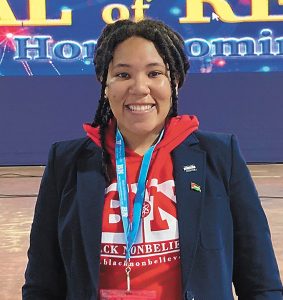
Below is Kyria’s talk to the “Revival of Reason” conference sponsored by Black Nonbelievers in March in Atlanta, which FFRF helped co-sponsor. FFRF is naming Kyria its first “Percy Shelley Student Activist,” a $2,000 scholarship fund set up by generous FFRF member Michael Meek, who was inspired by the poet. Shelley was kicked out of Oxford for circulating a pamphlet about the necessity of atheism.
By Kyria M. Santa
I want to thank Black Nonbelievers and Mandisa Thomas for this platform. It’s powerful to be in a space where I don’t have to explain myself, where my existence isn’t up for debate, and where I can be unapologetic.
I titled this talk “Why I’m Angry,” not from a place of rage, but from a refusal to suppress the righteous anger I feel about the oppression, ignorance and hypocrisy I witness daily. A significant part of this anger comes from my identity as an atheist.
Atheism shapes my worldview and my activism within the Black and Puerto Rican communities, where religion is pervasive. Christianity dominates Black spaces, while Catholicism, mixed with indigenous beliefs, dominates in Puerto Rican culture. This religious framework is ingrained in our history and family structures. But what happens when you say, “I don’t believe in God”? You’re treated like a traitor, as if you’ve abandoned your roots for questioning the unquestionable.
Growing up, I saw how religion was wielded as a tool of control, pacifying people and keeping them docile. I recall sermons urging us to respect the police even amid the Black Lives Matter protests, using scripture such as 1 Peter 2:13-16 to justify obedience. This scripture was often cited to encourage prayer for police officers, even those abusing Black individuals.
Moreover, many in our communities use the bible to explain our suffering. Genesis 15:13-17 is frequently invoked, suggesting that our historical enslavement was part of a divine plan. But why seek validation from a source that sanctioned our suffering? Why look to a cosmic figure who permits brutalization?
My anger stems from the rejection of these lies. It’s frustrating to see my own people dismiss atheists like me, especially when we demand real, tangible change.
As a queer woman, I find similar challenges in LGBTQ spaces. You’d think these spaces would be more accepting of atheists, given the harm many of us have faced due to religious beliefs. Yet, there’s often a reluctance to critique religion too harshly. I’ve encountered queer individuals who cling to faith despite its history of oppression, claiming, “Not all religious people are bad,” as if progressive interpretations erase centuries of harm.
I’m angry because religion has been one of our biggest oppressors. Faith and queerness can’t coexist without conflict, and I refuse to ignore that for the sake of comfort.
In academia, where one might assume atheism is safer, bias still exists. Although academia is less religious than other spaces, anti-atheist sentiments linger. In fields like public health, religious bias can influence discourse, especially regarding anti-vaccine movements. This is frustrating for students like me who seek truth in science. When scientific inquiry caters to religious sensitivities, my anger only deepens.
So, yes, I am angry. But my anger is not misplaced; it is necessary. It has fueled every major movement for justice. As an atheist, my anger comes from a place of love — love for truth, justice and humanity. I see how religion holds our communities back, erasing and demonizing atheists in spaces where we should belong.
I know that without the weight of religion, we could achieve so much more. That is why I speak out and refuse to remain silent. We must continue to push back against the narratives that seek to silence us. If we don’t advocate for ourselves, who will?
Kyria Santa is a first-year graduate student at the Rollins School of Public Health, pursuing a master’s degree in epidemiology. She is the founder and president of Emory (University) Secular Students, a community for Emory’s nonreligious students and allies who support secularism, in Atlanta. Kyria actively advocates for atheism and the separation of church and state, both in and out of the classroom. She is dedicated to raising awareness about the anti-nonbelief biases that persist within Black, Hispanic and LGBTQ communities.
