
7th place: High school essay contest — Andrew Christy
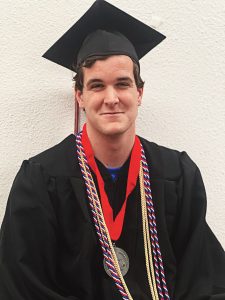
FFRF awarded Andrew $750.
By Andrew Christy
We live in a time of profound change, a tectonic shift in belief systems. As part of Generation Z, I have seen the contours of this shift firsthand. I am part of the 48 percent who identify as religiously unaffiliated or “None.”
Becoming a None is a unique adventure, a journey toward self-discovery and authenticity that has led me, and many of my peers, to reject traditional religious structures.
Growing up as a None, my experiences have been distinctly shaped by a persistent desire to question and critically evaluate the world around me. This inclination has been fueled by the digital era in which we reside, which has democratized access to information, expanded worldviews, and thrown open the doors to diverse beliefs. Instead of inherited ideas being bestowed, my generation has had the rare privilege of investigating, exploring and coming to conclusions. This journey of unguided exploration has often led to the rejection of the structures and doctrines of religion.
Why do I, and many of my fellow Nones, reject religion? The answer, though multifaceted, fundamentally revolves around the demand for rationality and equity. The inconsistencies, contradictions and inherent patriarchal and discriminatory structures found in many religions have resulted in disillusionment. This disillusionment is not to be mistaken for an outright rejection of spirituality or morality. Instead, it is an insistence on finding a spiritual path that resonates with personal experiences and upholds the values of equality and justice that we cherish deeply.
Additionally, the ostentatious display of religious symbolism that often masks underlying corruption, the appropriation of religion for political purposes, and the weaponization of faith to instigate conflict have only strengthened our decision to stay unaffiliated. My generation seeks a spiritual pathway where ethical actions hold more weight than symbolic rituals, where religious edicts do not limit love and acceptance.
Lastly, rejecting religious affiliation can lead to a more equal society. By refusing to adhere to doctrines that promote inequality, Gen Z is shaping a future that values every individual, regardless of gender, race or sexual orientation, free from the confines of religious prejudices.
The rise of the Nones does not signal an age of nihilism or moral bankruptcy, as some might fear. Instead, it announces an era where spirituality is personalized, ethical behavior is democratized, and the universal yardstick of human rights and scientific rationality measures progress.
The shift from religious adherence to religious nonaffiliation reflects a profound transformation, signifying a generation’s pursuit for authenticity, informed by ample access to information and a readiness to question the status quo. The emergence of the Nones is not indicative of a loss, but rather symbolizes an epoch of deeper introspection, comprehension and acceptance.
This development signals a transformative wave within the United States and beyond, propelling us toward an era where faith is regarded as a personal odyssey rather than an inherited doctrine, and where spirituality draws on the broad reservoir of universal human values, free from the constraints of religious dogma.
Andrew, 18, attends the University of Florida with plans to major in international relations and pre-medicine, and hopes one day to join Doctors Without Borders. He founded and manages his own business, Andrew’s Vending LLC, and co-owns a company at the Niceville Farmers Market. He was president of the Speech & Debate Club in high school and has volunteered at both a homeless shelter and thrift store.
