
6th place (tie): High school essay contest — Kamali Jangha
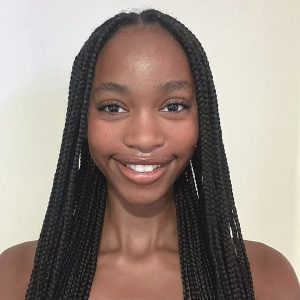
FFRF awarded Kamali $1,000.
By Kamali Jangha
I truly cannot imagine a world where I wouldn’t have grown up religious.
First, I am Black. This means going to church most Sundays, buying dresses specifically for church, and participating in youth choir and play productions. It means going to religious summer camps, where I met church girls whose mothers canvassed for Obama, and others whose mothers voted for Trump.
It also means that my exposure to Christianity was predetermined for me not by my parents or grandparents, but by the choice of slave masters and colonizers to indoctrinate those considered their property in hopes for a prosperous crop that season. Yet, the pain of my ancestors isn’t here with the congregation this morning. Instead, I am greeted by celebration, and the vitality of composers, dancers, musicians and a sea of people a hue not so far off from mine. For a long time, church was my best understanding of Black culture.
Second, I am a woman. I can distinctly remember my pastor encouraging women to reject promiscuity, and my mother’s words about my braless outfits ring clearly in my head. I could not understand how my “God-given” body could bring so much shame. I can’t remember when I realized that most women in the bible were side characters to men, or that in some parts of the world women are arrested and beaten for simply a stray strand of hair. I did begin to understand, however, that religion is not made equal for all of its believers, including me.
Third, I am queer. Like many issues in the Black community, I have never heard the queer community addressed in church. At a Chick-fil-A-sponsored sleepaway camp in rural Georgia, I ask my camp counselor the big question: What about gay people? She essentially told me queer people will have to apologize for their sins to reach heaven, or are otherwise going to hell. I was freshly 12 years old, and didn’t know I was gay, but did know it was unfathomably cruel. It is cemented in me again: Religion is not made equal.
This is when I separated the cultural practices of my church from the religion itself. Yes, there was a reason I stepped into the sanctuary and felt a part of something bigger than myself, but that something was not God. That feeling was the success of my ancestors, turning their pain and manipulation into celebration. I could be proud of my people and our strides, while still acknowledging the damage Christianity had done to me, us, and others globally. My generation, Gen Z, has already been monumental in effecting change. Not only in practice, but in ideas and the culture. Freedom from religion isn’t synonymous with damning yourself to hell, but to expansion of perspective and acceptance of all.
Kamali, 18, from Silver Spring, Md., attends Spelman College. In high school, she was active in student advocacy, and was secretary in her school’s Student Government Association and her countywide SGA.
