
1st place: Grad student essay contest — Sung Bin Roh
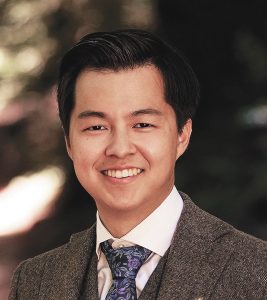
FFRF awarded Sung Bin $3,500.
By Sung Bin Roh
Christian nationalism has had a stronghold in American democracy for generations. In recent years, however, it has become more mainstream and threatens the secular democracy our nation was founded on, with the goal of turning the United States into a Christian theocracy.
Christian nationalism is the belief that a nation is a Christian one, where the government should promote and mandate Christian beliefs and practices throughout the legal system. This belief directly contradicts the separation of church and state and is currently taking away the rights of people across America. While Christian nationalism is certainly not a new endeavor for American Christians, it’s on the rise and as “Nones,” a growing group in this country, we must fight to prevent American democracy from becoming a Christian theocracy to protect everyone’s rights, not just our own.
On June 24, 2022, 49 years of precedent came crumbling down as five Catholic Supreme Court Justices ruled to overturn Roe v. Wade, eroding the legal framework protecting unenumerable rights, including birth control access, same-sex marriage and interracial marriage. As someone who is attending medical school and who will one day be a doctor, responsible for my patients’ health, I find it quite worrying and offensive that individuals who are trained in law are seen as fit to have the final say over medical issues. Because I am a person of color in an interracial marriage, the Dobbs decision, which has been discussed by Christian nationalists as a way to undermine the legality of same-sex marriage and interracial marriage, threatens the legality of my own marriage with far-reaching consequences.
Since before our nation’s founding, Christian nationalists have abused religious freedom to continually undermine civil rights. In the ongoing case of 303 Creative LLC v. Elenis, Lorie Smith is using the premise of religious freedom to bypass anti-discrimination laws. Her case will open the door for any business to freely discriminate against certain vulnerable groups as rooted in their specific Christian beliefs. Under the guise of religious freedom, Christian nationalists are undermining the separation of church and state in an attempt to strip away the rights of LGBTQ-plus people.
The majority of Americans identify as Christians, with both the Democratic and Republican parties vying for their favor. Hardly any attention is given to the “nones,” even as our numbers have grown from 9 percent to 29 percent in just the last 30 years. Today, only two members of Congress openly identify as Nones — a statistical anomaly — both publicly identifying as “unaffiliated” and “humanist” but not “atheist,” likely out of fear of discrimination and judgment.
I was once asked by a patient with whom I worked: “Why are you so nice? Are you a Christian?” He was shocked to learn that I was an atheist as he associated my kind behavior with Christianity.
After continued conversation, it was clear that expressing my atheism helped him feel more comfortable as he revealed his true agnosticism to me. He says he now identifies as a “recovering evangelical.”
Positive representation of atheists and “Nones” is key in the fight to defend secular democracy, as research has shown that exposure and education both decrease prejudice and discrimination.
According to a 2015 Gallup poll, 40 percent of Americans wouldn’t vote for an atheist to be president. Many Christians and religious folks alike judge atheists as being immoral and often evil because they trust and follow whatever they hear coming from the pulpit. If the secular movement is to progress, this pervasive stigma which runs deep throughout American society must be addressed. The secular movement, especially atheism, is currently viewed with a negative lens in the country. In order to defend secular democracy, we must also defend ourselves and increase positive representation and visibility of Nones throughout U.S. society.
The purpose of religious freedom is to protect the right of all individuals to freely practice their religion, or lack thereof, and prevent the government from favoring one religion over another.
Fortunately, Nones are not alone in the fight against Christian nationalism. There are many religious folks who understand intersectionality and respect the separation of church and state.
In the face-off for U.S. democracy, the fight is not between the Nones and Christian nationalists, but rather the Nones along with religious folks who support the separation of church and state and Christian nationalists. The secular movement must appeal to a broader audience than just the Nones in order to defend secular democracy and protect the rights of all Americans.
Sung Bin, 24, attends the University of Vermont Larner College of Medicine. He received the Kevin K. Gong Memorial Scholarship at UC-Berkeley for his work with CalMentors. Already fluent in Korean and English, Sung Bin advanced his Spanish language skills through medical Spanish courses after witnessing the lack of available translators when he worked as a medical scribe in a California border town. As a result of his efforts, he was able to translate for both providers and patients and provide more equitable access to health care.
