
In the News (December)
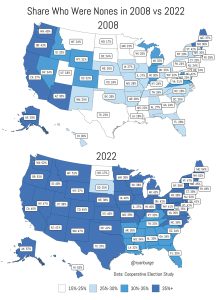
Nones are ‘basically everywhere now’
Ryan Burge, assistant professor of political science and graduate coordinator at Eastern Illinois University, put together these two charts showing the growth of the “Nones” around the country. This is the share of people who identify as atheist, agnostic, or nothing in particular in the 2008 and the 2022 version of the Cooperative Election Study.
In 2008, the Nones were way more concentrated in the western part of the United States. In 2022, nearly the entire map is a dark shade of blue, meaning those states have at least 35 percent of its population saying they are religiously unaffiliated.
“The Nones are basically everywhere now and in large numbers,” Burge writes on his GraphsAboutReligion blog site. “It’s not just isolated pockets in certain states.”
Jailed atheist released after winning lawsuit
A West Virginia inmate who was forced to participate in religious activities in order to be eligible for parole has been released from jail after winning his case earlier this year.
A federal judge in West Virginia had ruled in July that the state corrections agency can’t force an incarcerated atheist to participate in religiously affiliated programming to be eligible for parole. Saint Mary’s Correctional Center changed its policies after the ruling.
U.S. District Court Judge Joseph Goodwin said inmate Andrew Miller “easily meets his threshold burden of showing an impingement on his rights.”
The state’s “unmitigated actions force Mr. Miller to choose between two distinct but equally irreparable injuries,” the judge wrote. He can either “submit to government coercion and engage in religious exercise at odds with his own beliefs,” or “remain incarcerated until at least April 2025.”
33% of evangelicals OK with political violence
Support for political violence and concern over the state of American democracy are both on the rise, with 75 percent of Americans believing the future of democracy is at risk in the next presidential election, according to a report released Oct. 25 by the Public Religion Research Institute and the Brookings Institution.
Support for political violence has peaked above 20 percent, with 23 percent of Americans believing “true American patriots may have to resort to violence to save the country,” versus 15 percent in 2021.
One-third of white evangelical Protestants support the idea, significantly more than any other religious group. Americans who believe the 2020 election was stolen from Donald Trump are more likely to support the use of political violence than those who don’t think so (46 percent versus 13 percent).
The survey also delves into American’s adhesion to white Christian nationalist ideology. According to 33 percent of Americans, God gave America to European Christians as a promised land where they could create an exemplary society. More than half of white evangelical Protestants agree with this statement; 77 percent believe the Founders intended to create a Christian nation.
Americans who believed God wanted the United States to be a promised land for European Christians in turn are more likely (39 percent) to support the use of political violence to save the country than those who disagree (16 percent).
Mo. AG sues FDA over abortion-pill-by-mail
The attorney general of Missouri announced on Nov. 6 a lawsuit against the U.S. Food and Drug Administration over the agency’s approval of shipping abortion drugs through the mail.
Republican State Attorney General Andrew Bailey claims that the FDA had “unlawfully approved the shipment of chemical abortion pills in the mail.”
That case first drew national attention when federal Texas judge Matthew Kacsmaryk issued a controversial ruling on April 7 that suspended the FDA’s approval of the abortion drug mifepristone.
After the April decision, the Biden administration immediately issued an emergency appeal to block the ruling, first to a three-judge panel in the 5th Circuit. In August of this year, the 5th U.S. Circuit Court of Appeals ruled in that suit that the FDA must reinstate restrictions on abortion pills in place before 2016, with the decision banning administering the pills through the mail or via telemedicine.
The case is still pending. The Biden Justice Department in September asked the U.S. Supreme Court to overturn that ruling.
Young people define ‘sacred moments’ broadly
A majority of young Americans from a variety of faiths and no faith say they have experienced a sacred moment, according to a new survey, but their definitions of what is sacred may not line up with those of their parents or grandparents.
Springtide Research Institute’s “The State of Religion & Young People 2023: Exploring the Sacred” shows that 55 percent of the more than 4,500 people ages 13 to 25 who were surveyed said they have discovered what Springtide called “experiences that evoked a sense of wonder, awe, gratitude, deep truth and/or interconnectedness in your life.”
Of those who had, 69 percent said they had experienced a sacred moment more than once in nature, 68 percent said they’d done so in the privacy of their home, and 55 percent said at a place of worship. (Respondents could select more than one option.)
Nearly a third of those surveyed — 31 percent — said they had never participated in a spiritual or religious community. Also, there is a lack of trust among young people in organized religion, with 45 percent saying they only trust it “somewhat” and another 27 percent who trust it “not at all.”
Younger generations are leaving religion earlier
Children born in the 1980s and 1990s never absorbed faith in their home, so they walked away from it at an earlier age than most parents and leaders suspect, according to new analysis published at the Institute for Family Studies.
In the early 1990s, no more than 16 percent of 8th-, 10th- and 12th-graders said religion was not important to them at all, according to the study. By the early 2000s, however, the percentage of high school seniors who completely dismissed the importance of religion to them began to increase dramatically.
In the latest study, close to 30 percent of seniors and sophomores and almost 25 percent of 8th-graders said they didn’t consider religion to have any importance.
Survey: Belief in QAnon rises, even among Nones
There’s been an ominous uptick in the belief of QAnon-related claims between 2021 and 2023 spanning every demographic measured, reveals a recent survey from the Public Religion Research Institute (PRRI). This includes the religiously unaffiliated, although they still score better than any other religious demographic.
The percentage of Americans labeled by PRRI as “QAnon believers” has risen from 14 percent to 23 percent over the past two years.
White evangelical Protestants are the most likely to believe these claims (30 percent) while the religiously unaffiliated are the most likely to reject them. Still, the percentage of religiously unaffiliated Americans who are QAnon believers has doubled over the past two years, from 9 percent to 18 percent.
Iranian teen dies after alleged assault by police
A teenage Iranian girl who fell into a coma after she was allegedly assaulted by the country’s morality police for not wearing a headscarf died Oct. 30, according to Iranian state media.
Armita Geravand, 16, was declared “brain dead” despite the efforts of medical staff to save her. She was hospitalized with head injuries following the alleged assault at a Tehran metro station in October, according to activists, just weeks after Iran passed draconian legislation imposing much harsher penalties on women who breach the country’s already strict hijab rules.
United Nations officials and rights groups have previously accused Iranian authorities of pressuring families of killed protesters to make statements supportive of the government narrative.
Iran’s Parliament in September passed a so-called “hijab bill” on the wearing of clothing — which if violated can carry up to 10 years in prison — following the first anniversary of mass protests sparked by the death of Mahsa Amini.
Bill to disestablish Church of England set
A bill to disestablish the Church of England is expected to be introduced in British Parliament, after being selected from the House of Lords private members’ bill ballot.
The Disestablishment of the Church of England bill would formally separate the Church of England from the British state. It is expected to be introduced in Parliament on Dec. 6.
The Church of England’s established church effectively means it is the state religion of the United Kingdom.
British monarchs carry the title “Defender of the Faith and Supreme Governor of the Church of England.” They must be full members of the Church of England and must take an oath to maintain the Church during their coronation.
Additionally, 26 Church of England bishops are given seats as a right in the House of Lords. Iran is the only other sovereign state which reserves seats in its legislature for religious clerics.
For the first time, less than half of the population of England and Wales — 27.5 million people — described themselves as Christian, 5.5 million fewer than in 2011.
Florida can’t enforce drag show ban (for now)
The U.S. Supreme Court said Nov. 16 it will not allow Florida to enforce its new law targeting drag shows, while a court case proceeds.
The justices refused to narrow a lower court order that has prohibited the law from being enforced statewide.
Florida had asked the court to allow its anti-drag show law to be enforced everywhere except at the Hamburger Mary’s restaurant in Orlando, which challenged the law’s constitutionality.
Three justices — Samuel Alito, Neil Gorsuch and Clarence Thomas — said they would have granted the state’s request.
In October, a panel of the 11th U.S. Circuit Court of Appeals upheld a lower court’s order stopping the law from being enforced. The district court found that the law likely restricted free speech and couldn’t be enforced anywhere in the state.
Hamburger Mary’s regularly hosts drag shows, including family-friendly performances on Sundays that children are invited to attend. The restaurant’s owner said the law was overly broad, was written vaguely and violated First Amendment rights.
The new law championed by Gov. Ron DeSantis, who is running for the 2024 GOP presidential nomination, punished venues for allowing children into what it called “adult live performances.” Though it did not mention drag shows specifically, the sponsor of the legislation said it was aimed at those performances.
Pa. district to pay $200K to settle Satan Club suit
A Pennsylvania school district has reached a settlement with the Satanic Temple in a lawsuit alleging the district discriminated against students by barring them from allowing an After School Satan Club to use a school building earlier this year.
The American Civil Liberties Union said on Nov. 14 that The Satanic Temple, Inc., reached a settlement with Saucon Valley School District, and that the district agreed to pay $200,000 in attorney fees. The fees will be paid by the district’s insurance, and not the taxpayers, according to the district solicitor.
Under the settlement, the district must give the Satanic Temple and the After School Satan Club, which the Satanic Temple sponsors, the same access to school facilities that other similar organizations have. The ACLU filed the lawsuit in March, after the district did not allow the club to meet. The club says it does not believe in Satan, but uses the figure as a symbol of reason, independence and free thought.
Initially, Superintendent Jaime Vlasaty allowed the group to meet at a district space, but rescinded that after claiming the club violated board policy by not communicating it was not sponsored by the district. She originally said the club could use the facility because the district had allowed other religious groups to use rented space in the past.
The agreement also prohibits the district from retaliating against The Satanic Temple, the club, its members or volunteers, according to the ACLU.
Survey: Americans’ trust in science declining
Americans’ trust in science and scientists has dropped since the start of the Covid-19 pandemic, according to a report by Pew Research Center.
The percent of American adults who say science has a “mostly positive” effect on society fell to 57 percent, down 8 percentage points since November 2021 and 16 percentage points since just before the pandemic, according to the survey of more than 8,800 U.S. adults.
More than a third of respondents believed that the impact of science has been equally positive and negative, while 8 percent think science has a “mostly negative” impact on society.
Trust in science wasn’t the same across the political spectrum: The survey found that Republicans had less confidence in scientists and the benefits of science than Democrats. Less than half of Republicans (47 percent) said science has had a mostly positive effect on society, a decline from 70 percent in 2019. Sixty-nine percent of Democrats say science has had a mostly positive effect on society, although that has also declined by 8 points from 2019.
Mo. lawyers say abortion bans aren’t religious
Attorneys for the state of Missouri argued Nov. 15 that abortion bans aren’t inherently religious, even if lawmakers pass them because of their faith.
Lawyers for Missouri Attorney General Andrew Bailey’s Office asked a St. Louis circuit judge to make a ruling on his own, before a trial, against 13 religious leaders who sued earlier this year to block the state’s abortion ban.
The suit argued lawmakers imposed their religious beliefs on others in violation of the Missouri Constitution. But Maria Lanahan, with the Missouri Attorney General’s Office, said there are several reasons why someone may vote to ban abortion that have nothing to do with religion.
“Everyone has different reasons for passing a bill,” she said.
In their lawsuit, filed in January, Missouri Christian, Jewish and Unitarian Universalist leaders sought to block the abortion ban and stop local prosecutors from enforcing it.
U.S. bishops: Abortion a ‘pre-eminent priority’
The U.S. bishops will continue to highlight the threat of abortion as a “pre-eminent priority” in the introduction to a guide they’ll disseminate to Catholic voters ahead of the 2024 election.
That designation, the source of debate among some bishops in recent years, was retained when the bishops voted overwhelmingly (225-11, with seven abstentions) to approve a revised introduction to the guide, “Forming Consciences for Faithful Citizenship,” at their annual fall assembly Nov. 22 in Baltimore.
The bishops also voted to approve several brief excerpts from the guide to be inserted in parish bulletins during the upcoming election cycle.
“The threat of abortion remains our pre-eminent priority because it directly attacks our most vulnerable and voiceless brothers and sisters and destroys more than a million lives per year in our country alone,” the new introduction to the guide says.
The revised introduction also now states that the “redefinition of marriage and gender … threaten[s] the dignity of the human person.”
