
Bob Cenedella — Crucified: Religious censorship of art
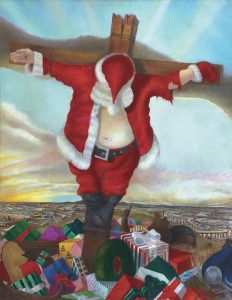
By Bob Cenedella
As an artist, I have never been able to free myself from the effects of religion. I thought I had actually become free from religion as the result of an incident at age 6. I remember being dragged to church by my grandmother on many Sundays and even some evening masses.
It was clear from day one that I would become an artist. So, even as a young child, I was very observant about the world around me. As much as I disliked having to go to church, I was rather obsessed with the stone statues of Jesus and other religious figures. While the sermon was in progress, in both English and Latin, for me it was simply boring.
But what I did find mysterious was one life-sized statue of what I was told was God (which really frightened me). I wondered, “Is he real?” I remember quite clearly looking at the statue and focusing on the head to see if it moved. The figure looked real and I was told God was real, but I wanted to catch him moving. It was an obsession every time I went to church.
That is, until one Sunday. The church was crowded and we sat near the sculpture, which allowed me to focus on whether he moved. If God were real, why didn’t he move? I was sitting on an aisle seat and wanted to see if I could touch him. I impulsively ran to the statue and climbed up on the pedestal and began pounding on the marble, much to the horror of my grandmother and everyone else.
I mention this early experience because it clearly had a profound effect on how I think about life in general and how I chose to express myself through my art.
I have often found the cross, as well as other Christian symbols, to be of great interest to me as an artist. Over the years, the power of the symbol led me to compose a great number of paintings and drawings that dealt with the subject of religion.
Each of these paintings or drawings incorporates a religious symbol to make a commentary on the role of religion in society in a way that only someone who had freed themselves entirely from indoctrination could. In this way, allegiance to organized religion acts as a form of censorship. An artist who feels an obligation to champion their own personal religion is not free to comment or criticize, at least not in any meaningful way. This dynamic plays out in other aspects of society, as well. The oil company executive is not free to discuss global warming and the politician cannot form an opinion if it contradicts party platform.
The audacity to challenge my grandmother so many years ago allowed me to free myself from religion. Much to my dismay, despite my personal liberation, my art is still not free from religion. Having overcome the first hurdle — developing a free mindset capable of creating unbiased art — a second hurdle arose: being allowed to show the art in public.
My painting of Santa Claus being crucified (“The Presence of Man”) is a perfect example. The moment the painting was displayed, Saatchi & Saatchi, known for being one of the most liberal collectors of the most avant-garde art in the world, reduced itself to censorship and pulled the painting from the exhibition without comment.
When, after years of censorship, it was finally displayed publicly on West 57th Street in the window of the oldest and most renowned art school in the world (The Art Students League of New York), the Catholic League of New York demanded the painting be taken out of the window. I ended up having to defend the painting to the media.
To this day, for the most part, the painting is denounced by critics (and ignored by the art community as a whole). I’m hoping that a more reasonable assessment of the painting will have its day in the court of rational public opinion at FFRF.
“The Presence of Man” is my interpretation of commercialism, in the form of the mythical Santa Claus usurping the spiritual value of Christmas. In my mind, it could almost be viewed as pro-religion, at least by those who value the actual religious aspect of the holiday, somewhat akin to the beloved holiday cartoon, “A Charlie Brown Christmas.”
So why then does it elicit such a vitriolic response from religious and nonreligious authorities? My best guess is that they are opposed to any type of critical thought being turned toward organized religion. Blatant censorship.
If no one ever sees the painting, no one will have the opportunity to entertain the issue of the connection between commercialism, capitalism and religion, which the painting is trying to elicit.
The result for the art world in general is that only art which has no subject matter, or offers only a banal perspective on society, will ever be exhibited on a meaningful scale. The result for me is that I am once again fearful (or at least mindful) of how organized religion will value my unique expression toward the subject of religion: a yoke I thought I had freed myself from as a 6-year-old.
