
FFRF convention wrap-up: Freethinkers’ powerful message
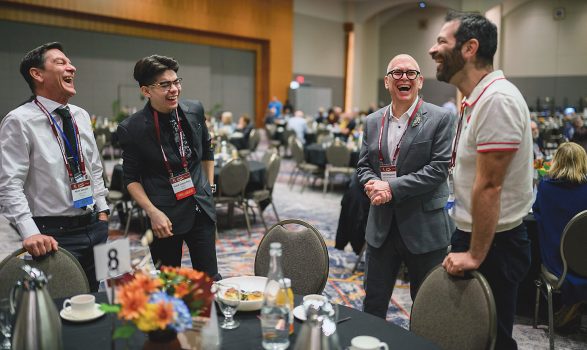
FFRF Director of First Impressions Matt Kenyon, student essay winner Isaiah Lopez Ruiz, gay-rights activist Jim Obergefell and FFRF Director of Governmental Affairs Mark Dann share a moment of frivolity at FFRF’s national convention in Milwaukee on Oct. 17.

“Genetically Modified Skeptic” Drew McCoy embraces FFRF PR Director Sara Tetzloff at FFRF’s national convention on Oct. 17.
By Sara Tetzloff
Acclaimed speakers, activists and honorees delivered a powerful message at the Freedom From Religion Foundation’s recent annual convention: The fight for secular democracy demands action.
More than 750 people preregistered for the Freedom From Religion Foundation’s 49th annual national convention, held Oct. 15–18 in Milwaukee, for a gathering that combined inspiration, irreverence and a renewed commitment to defending the separation between state and church. They represented 44 states, the District of Columbia, the United Kingdom and Canada.
The three-day event brought together members, advocates, lawmakers, attorneys, authors, educators and freethought activists to confront the growing influence of Christian nationalism, celebrate courageous defenders of constitutional rights and recharge batteries for the many challenges ahead.
From a congressional conversation about the threat of theocracy to deeply personal stories of standing up for freedom of conscience, the convention offered both a sobering assessment of the hurdles facing secular Americans and a hopeful reminder of what we can accomplish together.
Defending democracy
After various popular “early-bird” workshops by content creator Drew McCoy, FFRF legislative and legal staff and chapter leaders, the convention opened Thursday evening with a fascinating conversation between Reps. Jared Huffman, D-Calif., and Mark Pocan, D-Wis., discussing the growing Christian nationalist movement and its influence on the American government.
Huffman, co-founder of the Congressional Freethought Caucus, discussed his bestselling new book, “No Prophets: The Fight to Save Democracy from Christian Nationalism,” a personal examination of the movement’s political power and ties to the Jan. 6 insurrection. “We can beat this,” Huffman told attendees, emphasizing that confronting Christian nationalism begins with understanding its reach and building the political will to defeat it.
American Federation of Teachers President Randi Weingarten explored the connection between secular government, public education and democracy. Speaking about her book “Why Fascists Fear Teachers,” Weingarten warned about efforts to undermine public schools through privatization and religiously driven education policies. “Schools have to be safe and welcoming environments where kids feel secure, supported and accepted — all kids,” she said, underscoring the importance of protecting public education as a cornerstone of democratic society.
Maya Wiley, executive director of the Leadership Conference on Human Rights and Civil Rights, to which FFRF belongs, received FFRF’s Champion of Civil Rights Award. Wiley delivered a fiery address tracing the historical roots of white Christian nationalism and warning of its growing influence within government. Emphasizing the power of coalition-building across religious and nonreligious communities, Wiley called for unity in defending civil rights, freedom of conscience and the right to dissent: “To organize [Christian nationalism] into government? No, you don’t. No, you won’t, and we will stop you, because we are united.”
Kate Cohen, author of “We of Little Faith: Why I Stopped Pretending to Believe (And Maybe You Should Too),” argues that human rights and state policy should never depend on religious texts or interpretations, criticizing the government’s use of scripture as manipulative. She advocates for building a life “from scratch” by independently creating our own morality, values, and community without relying on ancient religious conventions.
Among the convention’s most moving moments was FFRF’s recognition of two Texas educators who resigned rather than participate in displaying the Ten Commandments in public school classrooms.
Gigi Cervantes, a former high school theater teacher, and Johnnie D. Cotton, a longtime band director, received FFRF’s First Amendment Hero/ine awards for putting their principles and students’ constitutional rights ahead of their livelihoods and professional security.
“I don’t want to be a hero. I would rather have continued teaching,” Cervantes said in a recorded acceptance speech, describing the heartbreak of leaving the students and classroom she loved.
The awardees’ experiences underscore the real-world consequences of Christian nationalist legislation — and the extraordinary personal courage sometimes required to resist it.
Legal victories, advocacy
The convention opened with an impressive survey on highlights of the year by FFRF Co-Presidents Dan Barker and Annie Laurie Gaylor. Annie Laurie noted she and her mother, feminist activist Anne Nicol Gaylor, actually founded FFRF regionally in 1976, making this year FFRF’s informal 50th anniversary. FFRF has grown from two to more than 40,000 members today and will be celebrating its official 50th anniversary as a national group in 2028.
FFRF’s legal and legislative teams provided a detailed look at the organization’s expanding efforts to combat state/church entanglements nationwide.
Legal Director Patrick Elliott, Deputy Legal Director Liz Cavell, Senior Counsel Sam Grover and Intake Attorney Madeline Ziegler highlighted successful interventions involving religious displays and activities in public schools, government agencies and other public institutions.
The team reported 13 pending lawsuits, including six legal challenges to laws mandating Ten Commandments displays in public school classrooms in Louisiana, Texas and Arkansas.
Attendees also heard about FFRF’s current victory before the Massachusetts Supreme Judicial Court involving proposed Catholic saint statues at a municipal public safety building, along with litigation challenging taxpayer support for religious charter schools and federal religious programming.
Regional Governmental Affairs Manager Mickey Dollens, a seated Oklahoma state legislator, Senior Policy Counsel Ryan Jayne and D.C.-based Governmental Affairs Director Mark Dann reported on FFRF Action Fund, FFRF’s advocacy affiliate, highlighting the growing impact of legislative and grassroots advocacy. In 2026, more than 16,000 advocates took action through the Action Fund’s online action center, generating about 36,000 emails to lawmakers. The team also reported that 88 percent of the state-level bills it opposed had failed to become law.
The presentations reinforced a central convention message: Protecting secular government requires action at every level, from individual school districts to state legislatures and federal courts.
Celebrating freethought
The convention’s distinguished honorees represented an extraordinary range of contributions to civil rights, literature, journalism and the advancement of secular values.
Jennifer Welch, the outspoken atheist and co-host of the popular “I’ve Had It” and “IHIP News” podcasts, received FFRF’s Emperor Has No Clothes Award, reserved for public figures who make known their dissent from religion. Combining biting humor with an impassioned critique of Christian nationalism, Welch discussed growing up nonreligious in Oklahoma and why she has made her atheism an unapologetic part of her public identity. She also delved into her brand-new bestselling book, “Not Today, Fascists: The Lies That Got Us Here, and the Truths That Will Reunite Us,” for which long lines formed during her book signing.
Pulitzer Prize-winning novelist and atheist Percival Everett also received the Emperor Has No Clothes Award. The author of “James,” an irreverent twist on “The Adventures of Huckleberry Finn,” captivated attendees with reflections on language, race, religion and the assumptions people make about one another, mixing literary insight with memorable storytelling.
Marriage equality pioneer and atheist Jim Obergefell received FFRF’s Forward Award and shared the deeply personal story behind the landmark Supreme Court case Obergefell v. Hodges. Recounting his relationship with his late husband, John Arthur, Obergefell reminded attendees that constitutional rights are ultimately about real people and the dignity of their lives.
Peter Isely, a survivor of clergy sexual abuse, co-founder of SNAP, psychotherapist and longtime advocate for accountability, received FFRF’s Clarence Darrow Award in recognition of his decades of work exposing abuse and institutional cover-ups.
The convention also honored in absentia imprisoned Moroccan feminist and atheist Ibtissame “Betty” Lachgar with the Avijit Roy Courage Award. International secularist and women’s rights activist Maryam Namazie accepted the award on Lachgar’s behalf, highlighting Lachgar’s imprisonment for alleged blasphemy and the urgent concerns surrounding her health. (See pages 6–8 for more details and how you can help.)
The Secular Coalition for America Education Fund received a major honor: the Henry Zumach Freedom From Fundamentalist Religion Award, which is now $75,000. SCA Executive Director Steven Emmert accepted the award and emphasized the importance of cooperation among organizations working to defend equal rights and secular government.
A late-night showing debuted FFRF Board Member and filmmaker Jeremiah Camara’s newest documentary, “Americaste: The Cast Behind the Curtain.”
The next generation
The convention looked to the future of the freethought movement, recognizing young advocates challenging religious privilege and building secular communities. Top-placing student essay winners Nyla Woods and Isaiah (“Cosmo”) Lopez Ruiz read their essays examining why Christian nationalism and white supremacy go hand in hand, bringing deeply personal perspectives to questions of equality, exclusion and constitutional rights.
Harvard student Ash Bu, the exuberant recipient of FFRF’s Percy Bysshe Shelley Student Activist Award, described her activism to build a campus community for humanists, atheists and agnostics. Bu argued for creating spaces where young nonbelievers can explore questions of morality, purpose and belonging without religious dogma.
Popular science and atheist communicators Drew McCoy, known as Genetically Modified Skeptic, and biologist Forrest Valkai offered additional perspectives on communicating secular values, countering misinformation and engaging audiences through science and critical thinking.
Valkai reminded attendees that the natural world offers its own extraordinary sources of meaning and wonder. McCoy challenged freethinkers to consider whether public debates with religious-right figures advance secularism or amplify their opponents’ arguments.
A powerful conclusion
The convention concluded Saturday evening with keynote speaker and commentator Ron Reagan, whose iconic FFRF advertisement identifies him as an “unabashed atheist, not afraid of burning in hell.”
Reagan received FFRF’s inaugural Robert G. Ingersoll Freethinker of the Year Award for his longstanding, outspoken support for freethought.
His keynote reflected on change, mortality, democracy and the responsibility to defend truth in an era of rising authoritarianism. “The truth is our most powerful weapon,” Reagan told the audience, urging Americans to remain informed, engaged and willing to speak out.
The weekend also included a spirited Godless Gospel performance, Dan Barker’s traditional musical offerings, book signings, freethought fellowship, drawing for “clean,” myth-dispelling pre-“In God We Trust” currency and FFRF’s signature NonPrayer Breakfast with its tongue-in-cheek “Moment of Bedlam.”
In another demonstration of its members’ extraordinary commitment, FFRF announced that supporters met a surprise $50,000 fundraising challenge, which inspired an additional $50,000 contribution to the organization’s work ($150,000 total)! Thank you!
As the weekend ended following Sunday morning membership meetings, attendees left Milwaukee with more than inspiration. They carried renewed determination to challenge religious privilege, defend constitutional freedoms and build a stronger, more visible freethought movement.
FFRF announced that its 50th national convention will take place at the Hyatt Regency Seattle, 808 Howell St., Seattle, Oct. 28–31, 2027, followed by the Baltimore Inner Harbor, 401 W. Pratt St., Baltimore, Sept. 21–24, 2028.
