
5th place: 2023 BIPOC essay contest — Vivien Talon
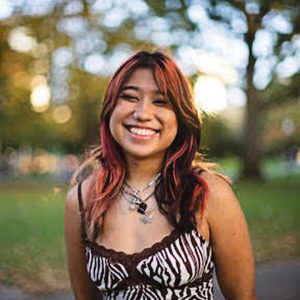
FFRF awarded Vivien $1,500.
By Vivien Talon
My separation from religion was a long transformation. Being raised in the Philippines before moving to the United States, my family was devoutly Catholic and so was everyone around me. I never even knew of anyone who wasn’t. However, my relationship to God was not one of faith but complacency. I was taught that he existed whether I bought into it or not, though if I didn’t, I couldn’t be a good person. More accurately, my relationship with religion was not a choice, but was a matter of avoiding the inevitable punishment that came from pursuing a reality without it.
After immigrating, I questioned my allegiance to the Church. Going to public school and finally meeting people who weren’t raised like me demonstrated that I could meet good people who weren’t even religious at all, and that they received no divine punishment. At school, religion wasn’t as pervasive in life as it was before — there was no prayer to start the day, no prayer before lunch, no prayer at all. At first it felt like a reprieve from what I regarded as a chore, but soon I noticed God’s absence beyond school. He was not there in my moments of suffering or triumph. At best, he was just a witness to my life.
Outside of God’s absence, the Church’s innumerable abuses further turned me away. In my own investigation of colonial remnants in and outside of my life, I saw how the Church creates and recreates oppression, justifying this harm with vague interpretations of archaic bible verses. Nonetheless, many maintain that religion nurtures empathy and community, and sometimes it can. Yet these messages are often shallow, preached with an underlying threat of what happens if one doesn’t reach one’s quota of good deeds — acts that uphold a certain group of people as the morally superior class. Such communities dehumanize those outside of their restrictive narratives, and even police one another to maintain this exclusivity. Thus, their consequences are overwhelmingly negative. In Filipino culture, I see how religion has been used to shame our indigenous heritage, equating Christianity (and whiteness) with civility. Now I yearn for a history I’ve never known. This supremacy persists in broader society, most apparent in legislation rooted in legacies of oppression — by denying necessary gender-affirming healthcare, withholding bodily autonomy from those with a uterus, and in violence against BIPOC.
Ultimately, religion leaves little room for nuance and villainizes critical thought. Religion provides an overly simplified worldview, offering scapegoats and too-easy answers to complex issues.
Those not governed by religion’s arbitrary values build communities with solidarity, and progress through critical introspection. I found liberation in detangling myself from religion and unlearning my religious guilt from freely thinking. Of course, I still bear respect toward religious people. It’s more accurate and effective to criticize their institutions, instead. But, in discovering my ability to find sound justification for causes I believe in, I’m far more impassioned and empowered than if I had confined myself to religion.
Vivien Talon, 20, is from Sparta, N.J., and attends Boston University, with plans to major in psychology and minor in public health.
“I am an active member at my school’s Filipino Student Association, where I am able to celebrate my Filipino culture with peers my age through dance, music and community,” Vivien writes. “I hope to pursue a career blending public health policies and action-oriented research on health conditions. I have also started an internship at a nonprofit called the Right Care Alliance, which empowers people affected my medical debt through research and protests.”
