
Action Fund offers hope in legislative report
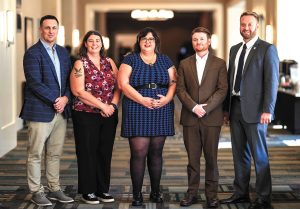
The FFRF Action Fund, featuring FFRF State Policy Manager Ryan Dudley, left, and FFRF Regional Governmental Affairs Manager Mickey Dollens, right, held a secular legislator panel during the 2025 convention with Vermont state Rep. Monique Priestley, Kansas state Rep. Heather Meyer and Minnesota state Rep. Andy Smith.
By Ryan Dudley
Hundreds of freethinkers, advocates and activists explored the beach for FFRF’s 48th annual convention. When convention attendees weren’t soaking up the autumn sun, they were treated to a schedule jam-packed with educational sessions and expert speakers. The FFRF Action Fund took to the stage to deliver a legislative report and the ever-popular Secular Legislator Panel.
Legislative report
In only its third year, the FFRF Action Fund had plenty of updates to share, leaving attendees with calls to action and hope for the future. We reported on a year of remarkable legislative engagement and advocacy, tracking over 600 new bills in 2025. The Action Fund opposed a majority of these bills and was happy to report that 88 percent ultimately failed to pass.
Since January, Action Fund advocates have sent approximately 87,000 emails and made more than 2,500 phone calls to elected officials across the country. These numbers shine a light on the passion the Action Fund’s advocates have for upholding the constitutional principle of secular government.
The Action Fund presentation also emphasized the significant increase in written testimony submissions. This substantial rise from previous years highlights the organization’s proactive engagement in shaping policy and promoting secular, evidence-based legislation. All testimony is accessible on the Action Fund’s website, FFRFAction.org.
Even with a difficult political landscape, the Action Fund touted several significant victories. We partnered with Unchained at Last to help Maine, Missouri and Oregon eliminate child marriage, raising their minimum marriage age to 18 without exception. Additionally, through collaboration with Compassion & Choices, the Action Fund safeguarded bodily autonomy against antiquated religious dogma by making Delaware the 11th state to legalize medical aid in dying, upholding individuals’ rights to end their lives on their own terms, with dignity.
Not all victories involve the passage of new legislation. In 2025, many of the Action Fund’s achievements stemmed from its success in thwarting detrimental bills. The Action Fund successfully helped stop Christian nationalist legislation across the country. For instance, the Action Fund reported on the crucial role we played in Oklahoma, halting several theocratic initiatives. In Alabama, we noted the collaborative work with various partners to prevent the enactment of five damaging public school bills. Similarly, in South Carolina, despite numerous regressive proposals, only one ultimately made it into law — a shameful resurrection of the state’s unpopular private school voucher program that was previously deemed unconstitutional by the state’s top court.
Finally, we highlighted the work of the newly revamped Rapid Response team. Showcasing the speedy work of FFRF attorney Chris Line in his new role as rapid response counsel, attendees saw how the team called out theocratic efforts in real time to increase our engagement with the public and elected officials alike. In particular, through its “Theocrat and Secularist of the Week” awards, the team publicly celebrated lawmakers and advocates who championed secular values while calling out those who promoted Christian nationalism in government. The awardees are listed on the Action Fund website.
Secular legislator panel
This year’s convention featured the third annual Secular Legislator Panel, a highly anticipated event that brought together influential freethinkers to discuss critical issues at the intersection of secularism and policy.
This year’s panel featured three openly nonreligious or humanist state legislators: Kansas Rep. Heather Meyer, Minnesota Rep. Andy Smith and Vermont Rep. Monique Priestley. Each legislator offered attendees a unique opportunity to gain insight into the challenges they face in their respective legislatures.
Smith was invited to describe his personal evolution, from being raised in a conservative evangelical household to becoming a progressive advocate and champion of reproductive freedom and secular government. As the owner of a bookstore and a self-described cinephile, he dug deep to note similarities between today’s current political climate and cinema. Smith left the audience with a call for more freethinkers to run for office and not be intimidated by the process.
Meyer, the first openly bisexual legislator in Kansas, shared her journey from her Kansas upbringing to her decision to run for office. She discussed the difficulties of upholding state-church separation in a staunchly conservative state and offered honest reflections on her experiences as a nonreligious lawmaker. Meyer also outlined her concerns about the primary dangers that Christian nationalism poses to vulnerable populations and what freethinkers can do to make their voices heard.
Priestley, a former tech entrepreneur and community leader, shared her journey to becoming a state legislator. She explained how her secular values inform her policymaking in Vermont, enabling her to prioritize inclusion, innovation and equity, even in areas with strong traditional religious influence. Priestley offered insightful reflections on the dangers posed at the cross-section of an authoritarian government, freethinking advocacy, and surveillance technology. Through her work with a nonprofit she founded and other grassroots initiatives, she confronts religious extremism in civic life, emphasizing the importance of fostering open and welcoming environments for everyone.
Each of the legislators on this year’s panel offered a candid view into life as a secular elected official in such a challenging political environment. But panelists left convention attendees with calls to action and a message of hope: We can make a difference, but we must not sit silently on the sidelines. Legislators encouraged the attendees to call or email their elected officials, testify at committee hearings, or even run for office; whatever it takes, we must ensure that we can turn our advocacy into action.
What’s up next?
Discussions about the current political climate inevitably elicit feelings of despair and anger, but the Action Fund made a point of leaving convention attendees with a hopeful message. Toward that goal, the Action Fund unveiled two new pieces of legislation to the attendees in the room: the KPOP Act and the CHARM Act.
The bill we’re calling the KPOP Act (Keep Proselytizing Out of Public Schools) seeks to codify longstanding Supreme Court Establishment Clause precedent into state law. To safeguard against the court’s ongoing dismantling of Establishment Clause precedent, it is vital that we enshrine protections into state law. This ensures that public school students remain free from coerced prayer, free from distracting and divisive religious displays, and free from feeling ostracized or inferior because of their beliefs while receiving a public education.
The CHARM Act is a simple bill that repeals harmful exemptions. In most states — approximately 40 — parents have a religious exemption from laws requiring them to seek appropriate medical care for a sick or injured child. These exemptions can effectively shield parents from legal consequences, even in cases where a child dies or suffers serious harm as a result of medical neglect. The CHARM Act aims to close a significant loophole: current exemptions effectively shield parents from legal consequences, even when a child suffers serious harm or death due to medical neglect. By enacting this legislation, all children, regardless of their parents’ religious beliefs, will have an equal right to life-saving medical care.
Conclusion
The Action Fund’s presentation highlighted progress despite rising religious extremism and political polarization. The KPOP and CHARM Acts further emphasize the Action Fund’s commitment to protecting children, defending freedoms, and keeping religion out of government. The wins from the past year serve as reminders that we are fighting the good fight. The Action Fund will continue to inspire our advocates to stand up for secular values and to remain strong in the face of an adverse political climate. We are on the right side of history.
Ryan Dudley is FFRF’s state policy manager.
