
Richard Katskee: The religious assault on science education
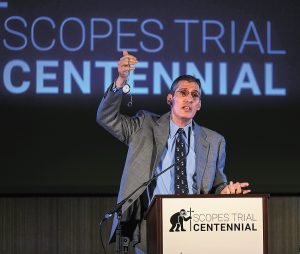
Richard Katskee holds up a timepiece while describing the intelligent design argument for the existence of God.
This is an edited version of the speech given by Richard Katskee at the Scopes Trial Centennial celebration in Chattanooga, Tenn., on July 19. He was introduced by comedian and convention emcee Leighann Lord. To watch the speech, go to ffrf.org/scopescon.
Leighann Lord: Our next speaker talks the talk and walks the walk. Richard Katskee is an assistant clinical professor of law and director of Duke’s Appellate Litigation Clinic. Previously, he was the legal director of Americans United for Separation of Church and State, where he was managing cutting-edge cases under the First Amendment’s Establishment, Free Exercise and Free Speech clauses. And, most notably, he taught First Amendment law at American University Washington College of Law and professional and political ethics at Harvard’s John F. Kennedy School of Government and Harvard College. So, he’s teaching and doing.
Please welcome Richard Katskee.
By Richard Katskee
John Scopes was charged with the crime of teaching evolution — actually, it was the crime of teaching anything about where humans come from other than what it says in the book of Genesis. He was convicted of the crime of teaching evolution and fined $100. That is $1,837 today on a teacher’s salary.
The Tennessee Supreme Court overturned the sentence on a technicality but upheld the conviction. So, no teaching of evolution became the law of the land and evolution was written right out of the science textbooks for decades.
I want to talk about the religiously based hostility to evolutionary theory and to give you a slice of that.
“Evolution Exposed” is a modern textbook by a creationist group called Answers in Genesis, and it’s pretty typical of creationist materials. Here’s how Answers in Genesis explains what is wrong with evolution:
“The great threat to society is moral relativism. The social concept of relative morality is based on evolutionary doctrine. If man is a product of random cosmic accidents, then man should be able to decide what is right and wrong, (if right and wrong even exist in humanist philosophy). The problem is that there is no basis for deciding what point of view is right or wrong. The bible provides absolute truth and authority for making moral decisions.”
Absolute truth. The bible isn’t allegory. It isn’t a guide to spiritual truths, it’s a history textbook. It’s a science textbook. It’s true, literally in every detail. No room for interpretation, no need for critical thinking. You just obey.
On this view, though, it turns out that there’s a problem. If the bible isn’t literally true in every detail, then it’s all a big lie. Its moral code is just made up. So, if evolution is true, the bible must be false, God doesn’t exist and, therefore, there is no right or wrong. It’s God or Darwin. You can’t have both.
Fundamentalism rises
That’s Christian fundamentalism, which was an innovation of the 1880s. Give us clear, easy answers to hard questions about how we should live when life is confusing. Now, in our nation’s history, rises in Christian fundamentalism have come as a backlash in periods of rapid social change.
During the 1880s, what we had going on was the Industrial Revolution, the rural to urban movement, leftover displacements from the Civil War that had turned into these broad demographic shifts.
Fundamentalism was an entirely new theology. The idea of reading the bible for yourself went back to the Reformation, to Martin Luther. But, biblical literalism — don’t analyze, just obey — that was new.
Now, after the 1880s, things settled down a bit and Christian fundamentalism kind of waned. It didn’t disappear, but it was less common until the 1920s, when soldiers were returning from World War I. After being exposed to new ideas in different ways while living in Europe, society had to absorb them. Women were protesting and finally getting the vote.
So, the fundamentalist backlash produced the monkey laws, outlawing the teaching of evolution as a threat to religion and therefore to society itself.
In the 1950s, we had the Cold War, Korean War, desegregation of the armed forces, Brown v. Board of Education, murder of Emmett Till — so much going on. Meanwhile, still no teaching of evolution. It was not in the textbooks. Then, in 1957, the Soviets launched Sputnik. The godless communists were suddenly ahead of us in science. So, the federal government sent researchers out to universities across the country asking, “How do we regain our place as the global leader in science?”
The answer they kept getting was: Teach evolution because it is the foundation of the life sciences. It wasn’t until 1968, in a case called Epperson v. Arkansas, brought by a 24-year-old high school biology teacher in Little Rock, that the U.S. Supreme Court held that states can’t bar the teaching of evolution because the Constitution forbids government to tailor teaching and learning to the tenets of a religion.
Then, in 1968, we had the civil rights movement, counterculture, Vietnam, just about to be the Summer of Love — turbulent times that gave fundamentalism a boost. But, after Epperson, religiously motivated opponents of evolution responded with what they called either creation science or scientific creationism.
Henry Morris was an engineer who had this idea that we can find hard evidence in the natural world to prove a literal interpretation of the bible that God specially created the universe and all living things. Special creation — that is a technical term that means designed and made things complete in their full final form.
One of Morris’s proofs was flood geology. The Earth isn’t 4.5 billion years old. It’s just 5,000 to 10,000. Now, Morris’s idea was this: We can’t teach religion in the public schools, but creation science, it’s science. It’s right there in the name. So, we can teach that.
He and his followers went around the country convincing state legislatures to enact balanced treatment laws. Can’t outlaw the teaching of evolution. Don’t require it, God forbid. But if you do teach it, you’ve got to give equal time to this new scientific alternative. In 1987, however, in a case called Edwards v. Aguillard, the U.S. Supreme Court struck down these balanced treatment laws.
The court recognized that creation science is a religious view and not science, and the public schools aren’t allowed to teach religion. Now, what’s a good creationist to do? How do you evolve? Out of creation science’s ashes rose intelligent design. Which brings me to one of the cases I did.
Kitzmiller v. Dover
You’ve heard about the Kitzmiller case. I was on the legal team for that case — Kitzmiller v. Dover Area School District in 2005. Dover is a little town in central Pennsylvania. It has one high school. In the summer of 2004, they needed new biology books. What they had were outdated because scientists are constantly learning new things, so the books have to change.
The teachers asked for Miller and Levine’s “Biology,” which, at the time, was used by 30 percent of high schoolers at both public and private high schools across the country. The Dover School Board, though, didn’t like these books because, as board member and chair of the curriculum committee William Buckingham put it, the book “was laced with Darwinism.”
The board decided that students should be taught creationism and wouldn’t purchase a biology book that didn’t do that. At a public board meeting, Buckingham defended the refusal to buy these books by saying: “It’s inexcusable to teach from a book that says man descended from apes and monkeys. I challenge you to trace your roots to the monkey you came from. This country wasn’t founded on Muslim beliefs or evolution. It was founded on Christianity. And our kids should be taught as such.”
He added: “Two thousand years ago someone died on the cross. Can’t someone take a stand for him?” And, that, of course, is what they did.
The board decided to buy a book called “Of Pandas and People,” which was the intelligent design textbook. The science teachers balked. A bunch of parents were up in arms. Then, the school received an anonymous donation of 60 copies of “Pandas” and put them in the science classrooms.
So, we sued on behalf of 11 parents with kids in the Dover schools. There were Protestants, Catholics, a Buddhist, nonbelievers, teachers, a nurse, a receptionist, a couple of folks who ran local businesses, a couple who taught their vacation bible school at their church. Just ordinary folks who cared about their kids, their community and their religious freedom.
Now, it was fall of 2005, and just days before we filed suit, National Geographic hit the newsstands with this cover story headline: “Was Darwin wrong?” What was the [magazine’s] answer? “No. The evidence for evolution is overwhelming.” The article explained that evolution is a theory. Then, it said, “If you don’t understand what scientists mean by a theory and you don’t know much about evolution, you might be inclined to think that it is just a theory.” That was language that the school board used.
But, when scientists say theory, they don’t mean “I have a hunch” or “I have a theory that oatmeal cookies are more healthy than chocolate chip.” A scientific theory is an extremely well-tested explanation that unifies a broad range of observations. So, the article explains, relativity is a theory, gravity is a theory, heliocentrism, which is the principle that the Earth orbits around the sun and not the other way around, that’s the theory, too.
Intelligent design?
What about intelligent design? Well, it is the view that some biological systems or organisms are so amazingly complicated that we just don’t believe they could have evolved gradually through natural selection. The idea dates back to the Rev. William Paley in 1802. Suppose, he said, you find a watch lying in the field, and if you take it apart and you remove any of those little bits and bobs, the darn thing just stops working. So, he said, you infer that it was designed and built by an intelligent agent. Same thing, he said, when you look at the human heart or the human eye — designed and built by an intelligent agent, somebody with a plan and a blueprint. This was Paley’s theological argument for the existence of God. The problem with calling that theological argument science is that science limits itself to natural explanations for natural phenomena.
The scientific method requires us to seek explanations that can be tested, repeated, falsified. If we can’t observe something (see, feel, hear, smell, taste it), as scientists, we can’t study it. It’s an untestable idea. An untestable idea may be true or it may be false, but science can’t tell us one way or the other.
By contrast, intelligent design, according to the National Academy of Sciences, makes a claim of supernatural intervention. That’s not science because it’s not testable by the methods of science. Intelligent design uses lots of scientific-sounding jargon, but in the end, it invokes a supernatural cause. Supernatural — out, above or outside the natural world. The divine. Science can’t invoke God to explain things because that requires a leap of faith, which is the province of religion.
This could, in fact, be true. Science can’t shed any light on it one way or the other. So, the question in the Kitzmiller case was: Is intelligent design science or is it religion?
To show that it’s religion, we started with the book “Of Pandas.” Here’s how “Pandas” defines intelligent design: “Intelligent design means that various forms of life began abruptly through an intelligent agency, with their distinctive features already intact — fish with fins and scales, birds with feathers, beaks and wings, etc.”
Special creation, that term I gave you before.
“Pandas” was first published in 1989. It used this same definition, but we knew that the manuscript had been under development for a long time, so we got the old drafts from the publisher, a group called the Foundation for Thought and Ethics, which is a Christian apologetics group in Dallas.
We found out that, in earlier drafts, this definition had been a bit different. “Creation means that various forms of life began abruptly through the agency of an intelligent creator.” We went through and had an expert count the uses of “creationism” and “intelligent design.” We found that pattern of substitution repeated more than 100 times.
So, the names change, but the story is always the same because this is ultimately a fight about names, labels and control of language to get creationism into the public schools without getting into legal trouble. The local newspapers in Dover ran hundreds of articles and editorials and letters to the editor, reporting and talking about how the school board was pushing creationism at its public board meetings.
The school board insisted that those were all made up. William Buckingham, that board member, said those were false. “I never said any of those.” So, at trial, one of my co-counsels questioned Buckingham about it.
Let me summarize what he said:
“I never talked about creationism. No other board member talked about creationism. Nobody ever used the word ‘creationism,’ not in public board meetings or to reporters, or even in private conversations. Didn’t happen.”
The testimony went on for a long time. Then my co-counsel asked, “Well, what about those newspapers articles quoting you?”
“I didn’t read them. Never saw them. Nobody told me about them.”
We then played a video clip from the local Fox News affiliate which showed Buckingham on his way into the school for one of those board meetings.
“The book that was presented to me for biology was laced with Darwinism from the beginning to the end.”
Reporter: “William Buckingham is head of the curriculum committee for the Dover School District. He’s also a board member. He strongly believes creationism needs to be taught in the classroom.”
Buckingham: “My opinion is that it’s OK to teach Darwin, but you have to balance it with something else, such as creationism.”
So, my colleague asked him, “That was you speaking, wasn’t it?” “Well, what happened was I was walking from my car to the building, and here’s this lady and here’s a cameraman, and I had on my mind all the newspaper articles saying we were talking about creationism, and I had it in my mind to make sure, make double sure, nobody talks about creationism. We’re talking intelligent design. I had it on my mind, and I was like a deer in the headlights of the car, and I misspoke, pure and simple. I made a human mistake.”
What about those 60 copies of “Pandas” that were anonymously donated to the school district? Well, it turns out that Buckingham, had stood up in his church on a Sunday morning, held up a copy of “Pandas” and told people that they needed to contribute to buy those books because we have to save these kids for Jesus. So, Buckingham collected the money, wrote a check, gave it to the school board president, a guy named Alan Bonsell, to give to his dad. It says at the bottom of the check in the memo area: “For ‘Of Pandas’ books.” So, Donald Bond bought the books and made that anonymous donation, but everybody knew what was going on.
Here’s a letter to the editor by a guy named Michael Freed, who’s a community member who supported the intelligent design policy and it’s one of many things we pointed to in the trial.
“I applaud the Dover Area School Board in backing intelligent design. Seems people want to take God out of everything. It’s high time to put God back in our lives and inform others of what he has to offer. Try God. If you don’t like him, Satan will gladly take you back.”
Now, Freed is sure that his religious beliefs are right and that anybody who doesn’t share them is going to hell. I want you to compare that to the testimony of one of the 11 parents I represented. Her name is Cindy Smith. Cindy and her husband run an appliance repair business in Dover. Their then 7-year-old son Griffin loved science.
Here’s what she said: “Well, as a parent, you want to be proactive in your child’s education. I mean, obviously, I’m not an educator. I have no big degrees. I want to be proactive, but I depend on the school district to provide the fundamentals. I consider evolution to be a fundamental of science. And, in my mind, intelligent designer is a synonym for creator, and that takes a leap of faith for me. I think it’s my privilege to guide my child in matters of faith, not a science teacher, not an administrator, and not the Dover Area School Board.”
The incredible judge in the case was appointed by George W. Bush and was a one-time Republican candidate for Congress. When it was announced that he would be the judge, the intelligent design crowd responded by really crowing because he’s one of their good old boys. They had him in the tank.
But, it turns out that in an absolutely magisterial 139-page opinion, Judge Jones applied the law. He ruled that intelligent design is not science, but religion, so it can’t be taught in the public schools. He explained: “The citizens of the Dover area were poorly served by the members of the board who voted for the intelligent design policy. It is ironic that several of these individuals, who so staunchly and proudly touted their religious convictions in public, would time and again lie to cover their tracks and disguise the real purpose behind the ID policy.”
Two Supreme Court cases
After Kitzmiller, the law was clear that that is unconstitutional. But, today, the U.S. Supreme Court has changed the meaning of the First Amendment in two recent cases, so, everything is kind of up for grabs.
One of them is Kennedy v. Bremerton School District, which you might remember from a couple of years ago. It’s the case about the public school football coach who had the prayers on the 50-yard-line with the students and the school district was trying to stop him. I represented the school district in the Supreme Court case. The Kennedy decision did two things. First, the Supreme Court said all those legal tests that we’ve had in place for, depending on how you count, 50 or 75 years or maybe 200, forget all those pesky tests and the conclusions that they lead to — no prayer in public schools, no teaching of religious doctrine in public schools — instead, look to history and tradition to decide what’s constitutional.
So, presumably, what this means is that if the court can find somebody, some time, some place, who did something religious in the public schools, that means it is constitutionally permissible for all of us all the time now.
The second thing that the Kennedy decision did was that the court held that this public school football coach, who had for eight years delivered homilies — little sermons and prayers — to the kids on the 50-yard-line right after the game, and now was having audible prayers, taking a knee, but being surrounded by the team and saying prayers on the field at the same time and the same place, that that was personal, private religious conduct that the coach has a constitution free exercise right to.
So, what does that mean now for the personal private conduct of teaching about evolution in science class, but holding a bible and saying “truth, right here.”
Finally, the Mahmoud v. Taylor case that the Supreme Court just decided a few weeks ago having to do with the LGBTQ-inclusive curriculum in Montgomery County (Md.) schools. The Supreme Court held that the parents who were bringing a religious challenge to some storybooks have a constitutional right to opt their kids out of things in the public school curriculum that threaten their religious beliefs. So, if there are enough parents who want to opt out of something that they don’t like, it becomes impractical to teach the subject because you have to do something with all the rest of the kids. That’s just too bad for the rest of us.
Now, make no mistake, there are plenty of parents who see evolution as a threat. So, this is where the fight is going to be now. And, hang on, because it’s going to be a bumpy ride.
